
Northward intermittent pulses of Antarctic Intermediate Water beyond the Brazil/Malvinas Confluence
Published in Progress in Oceanography, 2026
Abstract
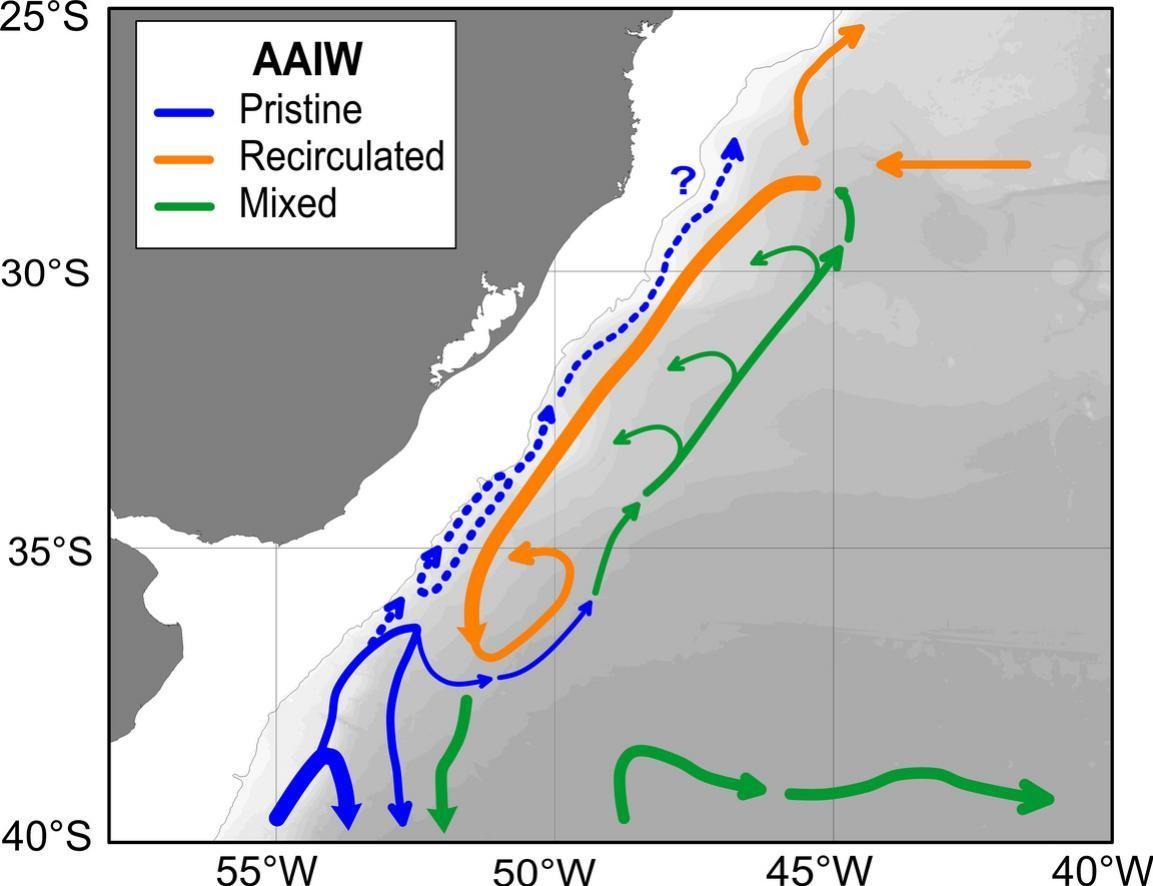
Antarctic Intermediate Water (AAIW) contributes to the northward flow required to compensate the export of North Atlantic Deep Water from the North Atlantic Ocean to other basins and therefore plays a crucial role in the Atlantic Meridional Overturning Circulation. Based on observations and outputs from an ocean reanalysis we present evidence of a narrow band of relatively fresh (≤34.20) and oxygen rich (>260 μmol.kg−1) newly formed AAIW which extends northwards, past the Brazil-Malvinas Confluence (BMC) up to 34.5°S. We investigated the probability of occurrence of this phenomenon, the possible driving mechanisms, and its seasonal and inter-annual variability. Our results indicate that this flow is weak and intermittent, confined to the upper continental slope near the 1000 m isobath. The mean travel time between 38 and 39°S, south of the BMC, and 34.5°S is 205–217 days; occasionally, during the development of intense pulses, the travel time reduces to less than 60 days. The mean particle velocity during pulses is 12.60 cm.s−1. A weakening or reversal of the southward flowing Brazil Current (BC) is observed prior to strong pulses; this circulation pattern could facilitate the northward pathway of relatively fresh AAIW. The BC intensifies during February-March and weakens during August-September; thus, the northward AAIW pulses are also observed more frequently in September. The northward extension of the relatively fresh variety of AAIW is also favoured by cyclonic circulations trapped against the slope onshore from the core of the BC.
Full text: View paper at Progress in Oceanography
Recommended citation: Michèle Baqués, Giuliana Berden, Marcela Charo, Paola M. Dávila, Alberto R. Piola, Northward intermittent pulses of Antarctic Intermediate Water beyond the Brazil/Malvinas Confluence, Progress in Oceanography, Volume 244, 2026, 103726, ISSN 0079-6611, https://doi.org/10.1016/j.pocean.2026.103726.